Highlights
Quote
I finished my undergrad in math, physics, and computer science at MIT in 2018, then worked as a machine learning engineer at Meta for two years.
Quote
Now I’m a professional at creating experiences of warm amniotic dreamlike oceanic soul-level relaxation through gentle touch, in a way also unwinds body tissues to resolve aches and pains, old injuries, and structural issues like forward head posture and scoliosis.
Quote
One of my friends described what I do as “physical therapy as a gateway drug to the infinite.” I also think of it as “if low-dose MDMA was also good for your body;” or “like the outcomes of rolfing, but achieved through a pleasant restorative dreamlike experience.”
Quote
The thesis is that with enough of a particular nervous system resource, body tissues start concretely self-rebalancing, and generally clearing structural issues in a way that boosts both longevity and immediate sense of wellbeing.
Quote
esoteric light-touch bodywork
Quote
I immediately started having experiences outside of their frames - experiences that seemed obviously therapeutically beneficial for the client.
Quote
Discrepancies like these are where new knowledge comes from.
Quote
They didn’t take long at all to show up, either! It was halfway through my six-month massage school program that I noticed, while giving a massage in prenatal class: wait, if I trace this particular elastic-y membraneous texture of the body as I do a massage stroke, my client exhales deeply, and I also feel startled into presence.
Quote
It seemed reproducible, so I kept playing with it over the next two years, and it kept deepening, even as my hands moved less and less, and the whole thing started looking less and less like massage. But my clients kept getting happier - we’d make more progress on their injuries, and emotional releases became more frequent. I decided I’d rather practice an unknown thing that gets more results, rather than something I was formally taught that got fewer results. So here I am.
Quote
“my hands are moving, but only 1/16th of an inch, and in a specific-to-the-client squiggle that coaxes their fascia to melt. After 15 seconds of this, the abnormal tissue has pulsed and re-arranged and re-integrated into continuity with the broader surrounding tissue, and my client has either relaxed or started dreaming.”
Quote
So I deepened my study of the non-massage modalities. But I don’t practice an off-the-shelf light touch modality either; I’m truly making my own.
Quote
And, another caveat - bodywork modalities are somewhat about “truth,” but they are also inherently an expression of how the founding practitioner’s perceptual space is best able to support the client pool that they see.
Quote
‘Bodywork’ is the umbrella term for ‘any health-supportive way to touch,’ and it includes non-massage modalities like craniosacral, myofascial release, and yes - regenerative touch!
Quote
I honestly wasn’t fulltiming my bodywork practice until year four. Before then, fully more than half of my time was going towards personal healing - both metabolic and physical and emotional. Unbeknownst to me at the time I walked into massage school, I had worse physical-structural issues than 95% of the clients I’ve seen since.
Quote
I say I went to massage school for fun, which is definitely true - but I was also in serious crisis at the time, and bodywork happened to double as the single most effective means towards my recovery.
Quote
Year two was broad-level and still mostly massage; things like “techniques for necks.” Now I’m in classes with medical-school levels of anatomical detail.
Quote
Putting in the hours in my practice (even now, my tactile sensitivity noticeably increases every ~10 sessions)
Quote
Massage school ended in April 2022
Quote
had a yearning sense of “is this all there is to life?”
Quote
It only took me a year to find out that - yep, there was way more to life. Turns out, life was both uncountably beautiful and uncountably painful in ways I never imagined. I struggled a lot, but NEVER with wondering “is this all there is?” I crossed a bridge into feeling meaning-rich, I’ve stayed that way ever since.
Quote
I still regard Asheville as a literal Narnia. In San Francisco, parties were filled with software engineers. In Asheville, parties were filled with massage therapists! In the Bay, the default spirituality is buddhism-flavored. In Asheville, the default spirituality is earth-based and animist. (I still wax poetic about Asheville; I have a separate post about it here.)
Quote
But also, by the time I recovered, I’d probably be qualified to do healing professionally for others.
Quote
Two months into having it, I found myself amidst the darkest, most hell-realm depression of my entire life; moreover I had sensory distortions that felt like I was on medium-low dose acid, except permanently.
Quote
But the loss of trust in the medical system, which I’d previously thought was rock-solid and something society had figured out, reverberated as ongoing trauma, and loss of existential trust in social systems to keep me safe.
Quote
I’d never felt anything like it before. And living inside those horrifying side effects of a ““““statistically safe”””” accepted and normal drug has definitely influenced me towards holistic approaches to wellness that work for any given concrete particular person, not the abstract ‘average person’.
Quote
Looking back, massage school did not remotely reach the depths of what my practice is up to now - but at the time it still felt profound, because it was learning along an axis of life (embodied, kinesthetic connection) that I had never paid attention to before.
Quote
Massage school felt quite economically approachable, too: it fit my “minimum-viable-education-that-would-certify-me-to-work” criteria. It was so cheap and short compared to college. Total cost was 10k, I forget exactly. And it was 600 hours! Meaning, part-time for 6 months
Quote
This was wayyyy, wayyyy more approachable than physical therapy school or chiropractic school, which are each multiple years long. Four years later, I’m super happy with my decision to go to massage school instead of one of those other schools. It felt like extremely high value for time and money, and allowed for quick iteration.
Quote
Over massage school I received so much bodywork, it was awesome. Simply being touched so much, in a variety of ways, boosted my body awareness.
Quote
Before starting school I barely had a ‘body map’ in my internal awareness, and I’d say the trades in massage school school alone got me 60% there. Now I still deepen my body map and increase it’s level of resolution - but there’s something quite special about going from “no body map” to “having a body map.” Zero to one.
Quote
And, while massage school may stick to basics - I genuinely endorse it for the sheer opportunity to put in hundreds of hours of practice at touching bodies. This is logistically hard to arrange, otherwise!
Quote
’ve heard a few bodyworkers say that something special happens after about 1000 hours of sessions given.
Quote
found that craniosacral required developing certain kinds of sensitivity that I did not yet have access to. So, the first class was curiosity-satiating, but not exactly a big unlock. This is what I mean about my learning rate speeding up: now that I have more tactile sensitivity and palpation skill, I get much more out of each class that I take.
Clean Copy
The transition from MIT/Meta math and tech; to intervening confusion; to massage school
Hi, I’m Elena! I’m a bodyworker-former-mathematician based in San Francisco. I started out on a hypertechnical career trajectory - I finished my undergrad in math, physics, and computer science at MIT in 2018, then worked as a machine learning engineer at Meta for two years. Then in 2021 I went to massage school for fun, and I found that the field went way deeper than I’d bargained for. Now I’m a professional at creating experiences of warm amniotic dreamlike oceanic soul-level relaxation through gentle touch, in a way also unwinds body tissues to resolve aches and pains, old injuries, and structural issues like forward head posture and scoliosis.
One of my friends described what I do as “physical therapy as a gateway drug to the infinite.” I also think of it as “if low-dose MDMA was also good for your body;” or “like the outcomes of rolfing, but achieved through a pleasant restorative dreamlike experience.” I haven’t seen anyone else do work quite like this, but I have a whole lot of underlying anatomical mental models for what I’m doing, and that’s why I’m creating my own modality called Regenerative Touch. (The thesis is that with enough of a particular nervous system resource, body tissues start concretely self-rebalancing, and generally clearing structural issues in a way that boosts both longevity and immediate sense of wellbeing. Also that human senses are so trainable, and with enough sensory training, bodywork becomes obvious.)
But this article is less about what I do, and more about how I learned it. Because it’s not quite what I was taught in massage school, and if you’re interested in learning it or related kinesthetic health skills, I want to save you some time!
And generally, I think tactile approaches to wellbeing are super underexplored and underinvested in, relative to how effective they are! So I’d love to see more people in this field!
How I got my start
I absolutely love my Regenerative Touch practice, but I also recognize it is not the default style of bodywork you’ll receive if you call up a randomly sampled bodyworker from your area. After standard massage education, I quickly took a hard pivot into esoteric light-touch bodywork.
This was emergent. If there was a conventional off-the-shelf modality I was fully satisfied with, believe me, I’d be practicing it! But as I began learning conventional modalities, I immediately started having experiences outside of their frames - experiences that seemed obviously therapeutically beneficial for the client. And, with my analytical background, I wasn’t about to ignore these experimental discrepancies with my pre-existing models. Discrepancies like these are where new knowledge comes from.
They didn’t take long at all to show up, either! It was halfway through my six-month massage school program that I noticed, while giving a massage in prenatal class: wait, if I trace this particular elastic-y membraneous texture of the body as I do a massage stroke, my client exhales deeply, and I also feel startled into presence. What’s that texture? It seemed reproducible, so I kept playing with it over the next two years, and it kept deepening, even as my hands moved less and less, and the whole thing started looking less and less like massage. But my clients kept getting happier - we’d make more progress on their injuries, and emotional releases became more frequent. I decided I’d rather practice an unknown thing that gets more results, rather than something I was formally taught that got fewer results. So here I am.
Now I explain this aspect of regenerative touch as “my hands are moving, but only 1/16th of an inch, and in a specific-to-the-client squiggle that coaxes their fascia to melt. After 15 seconds of this, the abnormal tissue has pulsed and re-arranged and re-integrated into continuity with the broader surrounding tissue, and my client has either relaxed or started dreaming.” But that clarity of language took longer to show up than the experiences themselves did. Also, it’s still evolving! Stay tuned for the eventual Intro to Regenerative Touch post I plan to write, hopefully soon…
But back to the story! Shortly after graduating massage school, I found not only that there was a world of esoteric light-touch bodywork modalities, but also that these modalities better matched the grain of the experiences that were happening on my table. So I deepened my study of the non-massage modalities. But I don’t practice an off-the-shelf light touch modality either; I’m truly making my own. I love information architecture so, I’m excited to do this! From my vantage point a few years later, my review of many existing modalities is: they’re roughly grab-bags of techniques that worked for the founders, and they don’t as much tend to originate from central axioms or core tenants. Or at least, much massage and bodywork education emphasizes the former at the expense of the latter. I expect Regenerative Touch to feel cleaner and clearer, and I’m excited for that!
That said, deepening into the world of non-massage modalities has also given me an appreciation for the simple power of massage. I do still include some massage as part of regenerative touch. And, another caveat - bodywork modalities are somewhat about “truth,” but they are also inherently an expression of how the founding practitioner’s perceptual space is best able to support the client pool that they see. So, my modality will not work for everyone, same as not every musician’s work will resonate for everyone, no matter how refined the craft of it. But it is the modality that I can personally do all day, to great effect. Meanwhile, one of my teachers is clearly constitutionally suited to be a deep tissue practitioner, and would be miserable if she was doing light-touch work.
(A note on definitions before I proceed: ‘bodywork’ is a term that includes massage, but it’s broader. All massage is bodywork, but not all bodywork is massage. ‘Bodywork’ is the umbrella term for ‘any health-supportive way to touch,’ and it includes non-massage modalities like craniosacral, myofascial release, and yes - regenerative touch!)
The first four years
At the time of writing this article, it’s been four years since I first set foot in massage school! Since then my arc has roughly been:
> Year 1: massage school and working at a spa
> Year 2: scattered continuing education classes;
> Year 3: FINALLY meeting advanced-level practitioners who think like me and I can nerd out with
> Year 4: finding better and better continuing education classes; my own practice finds its voice and takes off; deepening collaborations with colleagues
Also, I honestly wasn’t fulltiming my bodywork practice until year four. Before then, fully more than half of my time was going towards personal healing - both metabolic and physical and emotional. Unbeknownst to me at the time I walked into massage school, I had worse physical-structural issues than 95% of the clients I’ve seen since. I now hypothesize they started from a car crash I was in when I was 8 - but that’s a topic for another post.
But the “personal wellbeing journey” is also a big piece of how I got my start, and it’s how I first realized my unusual methods work for at least N=1. I say I went to massage school for fun, which is definitely true - but I was also in serious crisis at the time, and bodywork happened to double as the single most effective means towards my recovery. That’s still something I love about massage and bodywork as modalities. They’re so enjoyable - and they’re also seriously heavyweight treatments for depths of emotional and physical distress!
Also - there’s a big difference in depth and rigor between the continuing education classes I was taking in year 2, and the ones I’m taking now. Year two was broad-level and still mostly massage; things like “techniques for necks.” Now I’m in classes with medical-school levels of anatomical detail. In my practice I clear tension between people’s stomachs and diaphragms all the time; and in one of my last classes we went through ligaments of the spine and cleared them one by one. So, this means I spent hours sitting with my hands on a classmate’s back, learning to pick the textures of the anterior longitudinal ligament (etc) out of the soup of the rest of the textures in their body, and discerning which parts of that ligament wanted release and which did not.
How these articles are organized
I’d say my learning journey had six parts:
- Massage school (6 months part-time)
- Continuing education workshops
- Finding mentors whose work I admire, and learning directly from them
- Putting in the hours in my practice (even now, my tactile sensitivity noticeably increases every ~10 sessions)
- Trading sessions with colleagues
- Building my own interoception and intuition via movement, emotional, and spiritual practice
Massage school ended in April 2022, but the rest are still going! Honestly, my learning rate is speeding up! That’s part of why this article took so long to write.
Another reason it was kind of hard to write this article, is because my practice now is soooo different from the worldviews I inhabited when I began! But I still do recommend massage school as a starting place for learning bodywork. It is not on the cutting edge of what’s possible, but it sets a good grounding and foundation of a few hundred contact hours of experience with bodies. And it smooths out uneven development of embodiment skills: otherwise, many randomly sampled people walking around might be extremely talented via one bodywork-relevant skill but actively deficient in another, and also unaware of it. Massage school screens for this. My example of this is: I was overqualified at research and systemic thinking, so massage school anatomy and pathology class felt massively under-rigorous. But I also had no internal interoceptive body map at all, and it turns out that tracking your body map in realtime is both important for advanced bodywork, and an awesome quality-of-life-and-health boost! I’ll discuss my opinions of how massage school fits more into the broader bodywork landscape in part 3 in this series of posts - which is coming soon.
And yes, I mention “this series of posts” - maybe you’ve gathered, but there’s a lot in each of those 6 bullet points above! I could write multiple posts about each. But for now, I’m sectioning this series into three parts:
How I Learned Bodywork, Part 1: Transitioning From Tech to Massage School
How I Learned Bodywork, Part 2: Continuing Education Classes [Coming Soon]
How I Learned Bodywork, Part 3: Where I Recommend Starting [Coming Soon]
For the sake of chronological completeness I’m including parts 1 and 2, but if you’re short on time you’re welcome to skip directly to part 3. That is, once I write it:)
So with all that said - here’s part 1.
Transitioning from academia and tech, to massage school
In March 2021, I quit my job as a machine learning engineer at Meta. I was vanlifing at the time, inspired by a friend I’d met in San Francisco who had all sorts of far-flung life stories. She’d backpacked through Turkey and lived for four years on $20k total. She currently lived in a pickup truck, but was so charismatic that my community house kept inviting her to live in the empty rooms we’d have when people traveled. Everything she said about her life sounded like a campfire story. Meeting her cracked the door open for me into realizing that - there were many more ways to live than had previously occurred to me.
So, I found a van, asked her for her pickup-truck wisdom, and drove off. I didn’t know exactly what I was going to do after, but I wanted to see what other myriad ways of living existed, because I was dissatisfied with available paths I’d seen so far. I had a yearning sense of “is this all there is to life?”
It only took me a year to find out that - yep, there was way more to life. Turns out, life was both uncountably beautiful and uncountably painful in ways I never imagined. I struggled a lot, but NEVER with wondering “is this all there is?” I crossed a bridge into feeling meaning-rich, I’ve stayed that way ever since.
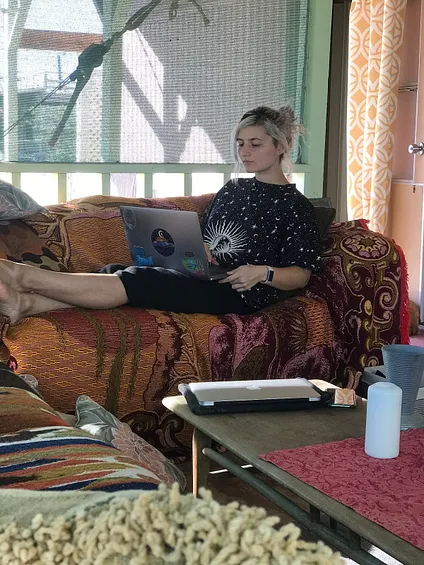
My fourth-to-last day on the job, in Bombay Beach CA.
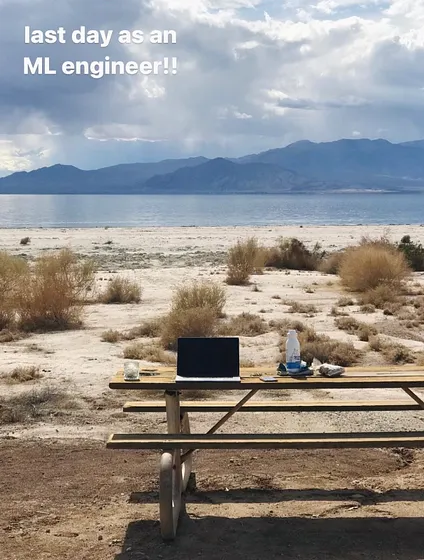
My literal last day on the job, out on the Salton Sea.
A big piece of this was that my vanlifing made a cross-country road trip that landed me in Asheville, North Carolina. I still regard Asheville as a literal Narnia. In San Francisco, parties were filled with software engineers. In Asheville, parties were filled with massage therapists! In the Bay, the default spirituality is buddhism-flavored. In Asheville, the default spirituality is earth-based and animist. (I still wax poetic about Asheville; I have a separate post about it here.)
Note, as a backdrop to all of this - I had egregious PTSD from a crisis in 2017. I was in weekly therapy, which was proving directionally helpful, but it felt like drops of water to someone dying of thirst. I needed much more, and I didn’t know what that might be. I tried ketamine therapy (review: meh?) and was also literally addicted to reading books about emotions (top rec: The Language of Emotions, by Karla McLaren). I had a sense that I was in such a deep emotional and nervous-system black hole that the only way I’d recover would be via a fulltime effort. But also, by the time I recovered, I’d probably be qualified to do healing professionally for others.
Spoiler alert - I recovered! And I now do healing professionally for others! I’m so grateful that both of those are true. There are still a few things I’m working out, and if you squint at the right angle you can see traces of my challenged past - but by western medical and psychological standards, everything is well. My continued process is via my own frames, going from “healthy” to “very healthy.” Because one of the things I’ve learned on my journey is that the ceiling of health is way higher than I was raised to think!
What was the crisis? One half of it was that I tried hormonal birth control - specifically, the Mirena IUD. Two months into having it, I found myself amidst the darkest, most hell-realm depression of my entire life; moreover I had sensory distortions that felt like I was on medium-low dose acid, except permanently. Colors became cartoonishly vivid, edges felt sharper, depth perception gave me vertigo, and sounds felt like they were inside my head. I wondered if I had a brain tumor. I tried describing my visual distortions to medical professionals and heard roughly “we’ve never heard of anyone experiencing that, sorry.” Then I scoured the internet until at last I found a few other people naming IUD-related sensory distortions, and got it removed after three months of having it. But the distortions, and the hell-realm levels of depression (that no glimmers of happiness could even remotely budge) persisted unchanged for another three months, and then took an additional nine months to return to baseline. But the loss of trust in the medical system, which I’d previously thought was rock-solid and something society had figured out, reverberated as ongoing trauma, and loss of existential trust in social systems to keep me safe. Thinking back now to the depths of that depression - wow, I am so grateful to be so far away from it now. I’d never felt anything like it before. And living inside those horrifying side effects of a ““““statistically safe”””” accepted and normal drug has definitely influenced me towards holistic approaches to wellness that work for any given concrete particular person, not the abstract ‘average person’.
The other half of the crisis was a romantic relationship that turned abusive! My childhood was solidly “ok” and was not itself acutely traumatizing, but the general absence of adult emotional skill in my upbringing left me very unprepared to guard against potential emotional hazards. So, oops, I found myself in one. I have a lot of gratitude for friends, and also MIT’s VPR department, for helping me out of the acuteness of that. But the longterm aftereffects manifested as the other half of the PTSD, which was still with me in 2021 when I began vanlifing.
Needless to say, in March 2021, I didn’t have a future career picked out. I’d saved up four years of living expenses, and I figured that if I had enough wherewithal to get an MIT degree and work at Meta, I could probably come up with something else financially viable, that I liked better, within four years. I had a vague sense of wanting to do something related to holistic health. So, I identified the online Institute for Integrative Nutrition as a minimum-viable-education-that-would-certify-me-to-work, and finished it. It was about $4k, five hours a week, and six months part-time, and I took on a handful of health coaching clients! But ultimately, it didn’t reach the level of rigor I wanted, nor the level of helpfulness to my clients. In 2025, I haven’t thought of it once. Mostly I mention it to show that - there was some experimentation along my journey, including dead ends and stepping stones. I genuinely didn’t know I’d wind up here, because I didn’t know the bodywork path was so fruitful, nor such a good fit for me. But now I’m so grateful I’m here!
Oh, since I mention experimentation and stepping stones - in 2021 I also interned with a local Ayurvedic practitioner! But I also haven’t thought of that in a long time, even though I’m clearly still on the Ayurveda path, and even collaborating deeply with Jessica Vellela.
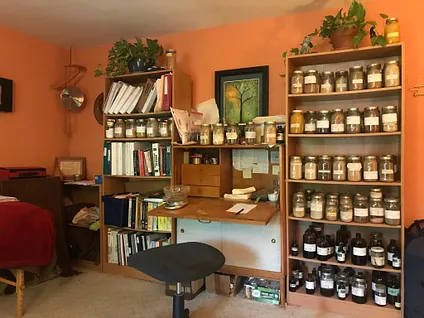
The Ayurveda office I interned at in 2021, where I’d help mix tinctures and herbal formulations.
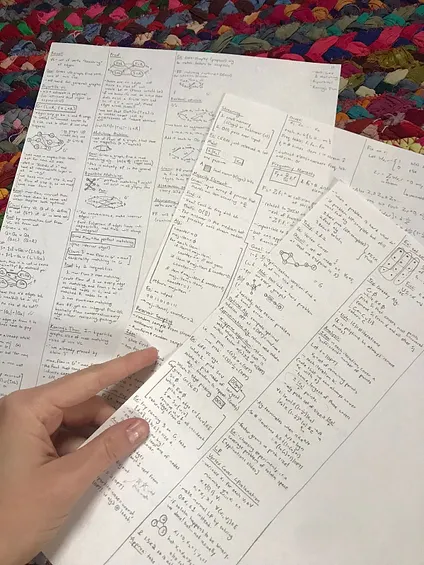
Here’s some of my old math and computer science notes from my academia days. I always liked pouring over a subject with diligence and intent. That trait of mine feels just as happy in bodywork as in math!
Massage School
In August 2021, I set foot in massage school for the first time. Looking back, massage school did not remotely reach the depths of what my practice is up to now - but at the time it still felt profound, because it was learning along an axis of life (embodied, kinesthetic connection) that I had never paid attention to before. I was also super surprised there were massage schools - that it was possible to be studious about kinesthetic connection*.*
I went both for fun and for personal healing; I didn’t have it picked out as my career yet. But I did have a hunch that the economics of bodywork might actually work out such that I could see it being a career. So the career-shift was a potential, albeit not a certainty.
And when I say “I went to massage school for fun,” what I mean is - I’d met my friend Jane in April 2021. She was a software engineer who was enrolled in massage school, and whenever she talked about it I kept asking her for more and more stories - until I realized that was a sign that I should probably go to massage school myself! She also wrote about bodywork with a level of attunement and real magic and sensitivity that I frankly hadn’t seen before. But once she pointed out the depths, I felt them too.
Massage school felt quite economically approachable, too: it fit my “minimum-viable-education-that-would-certify-me-to-work” criteria. It was so cheap and short compared to college. Total cost was 10k, I forget exactly. And it was 600 hours! Meaning, part-time for 6 months. It was two days a week (8hr days) for three months, and then three days a week for another three months. This was wayyyy, wayyyy more approachable than physical therapy school or chiropractic school, which are each multiple years long. Four years later, I’m super happy with my decision to go to massage school instead of one of those other schools. It felt like extremely high value for time and money, and allowed for quick iteration.
The Experience
My first day in massage school, I was anxious and scared to touch a body, because “what if I break something??” I’m so, so glad to see how far I’ve come since then!
And to that end, if you’ve been following my work with Regenerative Touch - the part where I talk about the tendency of fascia to self-organize when in an appropriately resourced nervous system state, and how to bring that about via touch - massage school will not come near that. It is an intro to basics. It covers many modalities that are not part of my toolkit or my set of lenses any more - for example, we had classes on shiatsu and Swedish massage and trigger point therapy. (Here’s a link to the curriculum of my massage school.) When I was in school, I assumed the existing material represented the best possible ways of approaching bodies - and I’ve been quite surprised to find plenty of discoveries (i.e. my work with the therapeutic pulse response of fascia) easily accessible outside of standard modality lines.
Generally, massage school might be low-rigor for folks used to intellectual complexity - I clearly wasn’t in math or algorithms classes anymore. We’d learn things that weren’t as logically airtight as I was used to; most of the material felt a bit “fuzzy” around the edges. So, things would make 80% sense, but there wasn’t a clear way to take it to 100%. I was partly frustrated, but also I got comfortable with that being enough. For example, we’d learn a set of techniques in shitatsu class - but, why those techniques, where did they come from? Shrug, it’s what the teacher was taught.
But the embodied aspect of it still definitely stretched me! In shiatsu class, I’d absolutely have an experience of building the coordination to replicate the routines on a classmate. I got to feel clumsy and made of uncoordinated limbs, and humbled by the simplicity of showing up to give my classmates a nice supportive experience. And the experience of receiving so much bodywork was also irreplaceable!
In school, we learned by practicing on each other. We did a trade with a classmate nearly every day! And the teachers set it up specifically so that each of us worked with everyone else, because every person’s body and quality-of-touch are different. So the teachers knew that we’d learn more from working with the whole variety of classmates than we would from picking our friends and sticking with them.
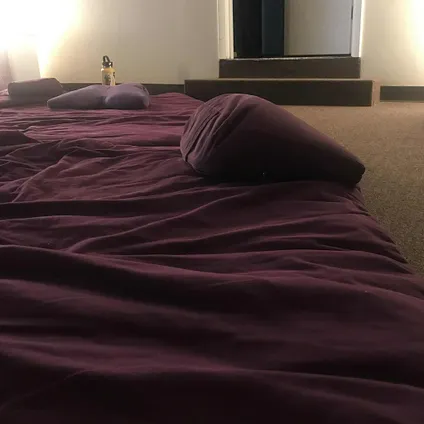
I barely took pictures of massage school, but here are some shiatsu mats from shiatsu day.
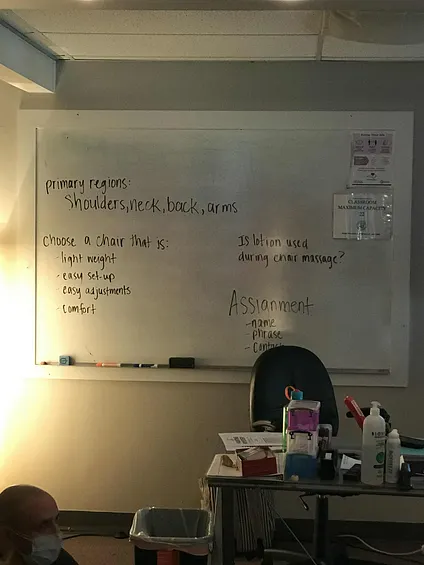
The whiteboard during chair massage class.
Over massage school I received so much bodywork, it was awesome. Simply being touched so much, in a variety of ways, boosted my body awareness. Before starting school I barely had a ‘body map’ in my internal awareness, and I’d say the trades in massage school school alone got me 60% there. Now I still deepen my body map and increase it’s level of resolution - but there’s something quite special about going from “no body map” to “having a body map.” Zero to one. Nevermind that I’d also sometimes go into the profoundly rejuvenative oceanic dreamlike trance states from, simply receiving normal massage. That seed showed up even in massage school, and was plenty enough to keep me motivated, though I couldn’t yet reproduce it.
Another fondness I have for massage school is that, after academia, it was so refreshing to be part of a cohort of healers. We shared similar emotional and spiritual values around taking care of one another and life on earth, and that was quite sweet.
Other notes: I didn’t do research about “which massage school was the best one,” I just went to whichever one my friend Jane had gone to. I still endorse this decision, because - it got me out there in the world, practicing, quickly. It did the job.
And, while massage school may stick to basics - I genuinely endorse it for the sheer opportunity to put in hundreds of hours of practice at touching bodies. This is logistically hard to arrange, otherwise! I worked at a spa for a little bit, after I graduated, for the same reason - I wanted to get my reps in, to build the levels of tactile sensitivity that only come online with repeated practice. (That, and I like the artistry of creating rejuvenative experiences for people, so working at a spa felt like a great match for that.) I’ve heard a few bodyworkers say that something special happens after about 1000 hours of sessions given. By now I’ve lost count of how many I’ve given, but, probably I agree? The change in my skill level between when I started and now is just so vast, and it shows no signs of plateau-ing yet.
In support of ‘putting the reps in,’ most massage schools have a 100-hour-ish requirement for “supervised clinical practice.” In order to graduate, we had to see clients! My school had a 5-room clinic space attached where, one day of the week, five of us would see clients who’d booked a student massage. All my classmates and I were so nervous on day one! But then we got used to it, over the 12-week period. This was a great “training wheels” period that I look back on with gratitude.
Ultimately the whole process of massage school left me with an appreciation for trade school. Unlike college, where I was sort of amorphously there for four years, learning whatever was on offer, massage school was straightforward. I was there to learn a particular skill. Before going, I did not know the skill. Upon graduating, I did! No extra fluff. Very to-the-point. Also, my classmates came from all walks of life. Some from restaurant jobs, some fresh out of high school, one 60-year-old dog breeder - and we connected over our genuine shared interest in bodywork.
The curriculum
That said, even though I consider massage school extremely “to the point,” we also learned a lot of modalities that aren’t frames I’m particularly interested in today. For example, here’s one of my homework assignments about trigger points! I dutifully learned what I was taught, and when I began I assumed the material represented the best possible ways of approaching bodies. In the years since, I’ve found that some modalities simply do not go as deep as others. For example, trigger point work left me lacking answers to key questions like “are there reliable external sensory cues that help detect these, or do we simply need to memorize the locations?” and “Are they in different places on different bodies; if so what does the placement depend on?” so I lost interest.
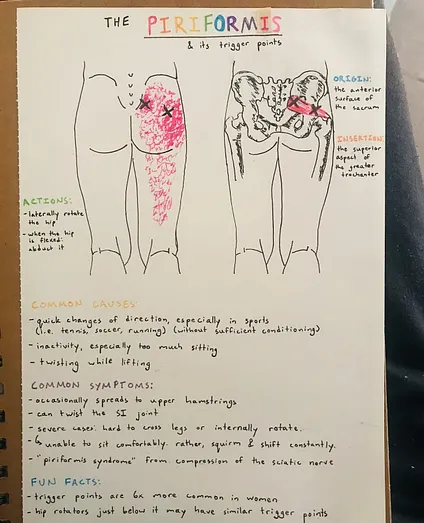
A homework assignment I did for trigger point class.
For the curious, here’s a copy-pasted curriculum of my massage school:
Massage & Bodywork Therapy: 252 Hours. Swedish Massage, Neuromuscular Therapy, Sports Massage, Pregnancy and Geriatric Massage, Hydrotherapy, Spa Treatments and Aromatherapy, Chair Massage, Thai Massage, Reflexology Massage, Integrative Massage
The Sciences: 202 Hour. The Musculoskeletal System, General Anatomy, Physiology & Pathology, Oriental Medical Theory
Allied & Self-Care Modalities: 40 Hours. Somatic Psychology, Energy-Based Work, Diet & Nutrition, Herbology
Professionalism: 40 Hours. Business & Marketing, Professional Ethics, North Carolina Laws & Rules
Orientation, Reviews & Finals: 20 Hours. Orientation, Exam Review, Final Exam
Supervised Clinical Practice: 100 Hours. Supervised by Licensed Therapist, All sessions are hands-on and with real-time feedback, Onsite private massage rooms (with walls, not curtains).
Onwards
Before I even graduated, I was already taking continuing education classes. Again, credit to my friend Jane for the inspiration! We took Craniosacral 1 together, with the Upledger Institute, in Sedona AZ. How could I not, when I’d read things like this - about experimentally measurable voltage changes from emotional release of “energy cysts”? I had to go investigate for myself.
What did I find? Well, you can read about that in the forthcoming second post:) which will be my in-depth review of the landscape of continuing education classes. But the short version is: I found that craniosacral required developing certain kinds of sensitivity that I did not yet have access to. So, the first class was curiosity-satiating, but not exactly a big unlock. This is what I mean about my learning rate speeding up: now that I have more tactile sensitivity and palpation skill, I get much more out of each class that I take.
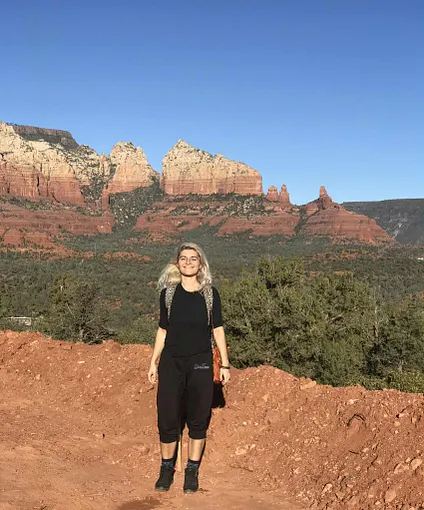
In Sedona, for CS1.
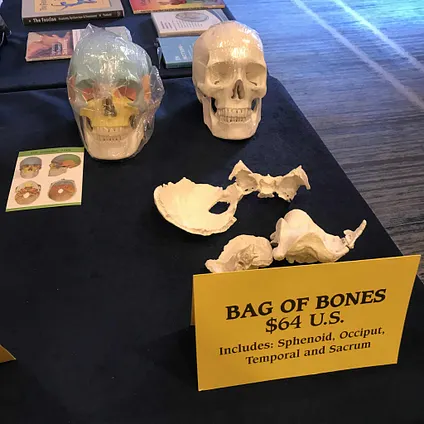
Yay anatomy!
So overall, my review of massage school is: excellent and truly irreplaceable for the embodied practice! A little short on mental models, but, the ones it provided were a good overview of the general state of the field, and therefore good indications of what work remains to be done. But even if you’re not interested in pursuing bodywork as a career, I found massage school to be a great experience, and I’d recommend it simply for fun and personal inquiry, too.
I became different as a result of massage school: more fully-fleshed out, and more landed as a person who lives three-dimensionally on earth. There are types of knowledge that are only available after you’ve had a particular experience - no amount of thinking will ever make them come about. Massage school provided some of these for me.
What might you be like after 100 hours of massage given and received?
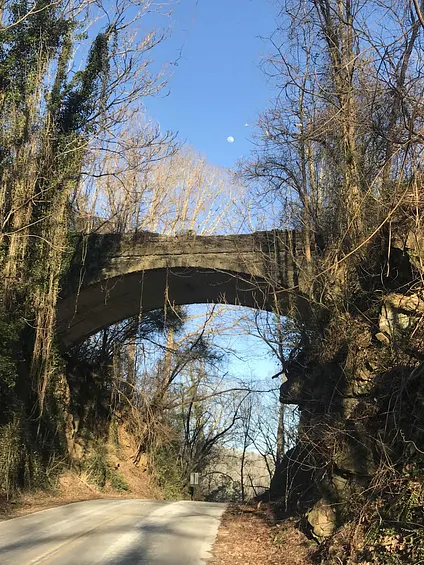
Here is one of the Asheville landscapes I would walk through often, when I was in massage school. Shared for a sense of place and season (I was in the winter cohort).
Annotated Copy
The transition from MIT/Meta math and tech; to intervening confusion; to massage school
Hi, I’m Elena! I’m a bodyworker-former-mathematician based in San Francisco. I started out on a hypertechnical career trajectory - I finished my undergrad in math, physics, and computer science at MIT in 2018, then worked as a machine learning engineer at Meta for two years. Then in 2021 I went to massage school for fun, and I found that the field went way deeper than I’d bargained for. Now I’m a professional at creating experiences of warm amniotic dreamlike oceanic soul-level relaxation through gentle touch, in a way also unwinds body tissues to resolve aches and pains, old injuries, and structural issues like forward head posture and scoliosis.
One of my friends described what I do as “physical therapy as a gateway drug to the infinite.” I also think of it as “if low-dose MDMA was also good for your body;” or “like the outcomes of rolfing, but achieved through a pleasant restorative dreamlike experience.” I haven’t seen anyone else do work quite like this, but I have a whole lot of underlying anatomical mental models for what I’m doing, and that’s why I’m creating my own modality called Regenerative Touch. (The thesis is that with enough of a particular nervous system resource, body tissues start concretely self-rebalancing, and generally clearing structural issues in a way that boosts both longevity and immediate sense of wellbeing. Also that human senses are so trainable, and with enough sensory training, bodywork becomes obvious.)
But this article is less about what I do, and more about how I learned it. Because it’s not quite what I was taught in massage school, and if you’re interested in learning it or related kinesthetic health skills, I want to save you some time!
And generally, I think tactile approaches to wellbeing are super underexplored and underinvested in, relative to how effective they are! So I’d love to see more people in this field!
How I got my start
I absolutely love my Regenerative Touch practice, but I also recognize it is not the default style of bodywork you’ll receive if you call up a randomly sampled bodyworker from your area. After standard massage education, I quickly took a hard pivot into esoteric light-touch bodywork.
This was emergent. If there was a conventional off-the-shelf modality I was fully satisfied with, believe me, I’d be practicing it! But as I began learning conventional modalities, I immediately started having experiences outside of their frames - experiences that seemed obviously therapeutically beneficial for the client. And, with my analytical background, I wasn’t about to ignore these experimental discrepancies with my pre-existing models. Discrepancies like these are where new knowledge comes from.
They didn’t take long at all to show up, either! It was halfway through my six-month massage school program that I noticed, while giving a massage in prenatal class: wait, if I trace this particular elastic-y membraneous texture of the body as I do a massage stroke, my client exhales deeply, and I also feel startled into presence. What’s that texture? It seemed reproducible, so I kept playing with it over the next two years, and it kept deepening, even as my hands moved less and less, and the whole thing started looking less and less like massage. But my clients kept getting happier - we’d make more progress on their injuries, and emotional releases became more frequent. I decided I’d rather practice an unknown thing that gets more results, rather than something I was formally taught that got fewer results. So here I am.
Now I explain this aspect of regenerative touch as “my hands are moving, but only 1/16th of an inch, and in a specific-to-the-client squiggle that coaxes their fascia to melt. After 15 seconds of this, the abnormal tissue has pulsed and re-arranged and re-integrated into continuity with the broader surrounding tissue, and my client has either relaxed or started dreaming.” But that clarity of language took longer to show up than the experiences themselves did. Also, it’s still evolving! Stay tuned for the eventual Intro to Regenerative Touch post I plan to write, hopefully soon…
But back to the story! Shortly after graduating massage school, I found not only that there was a world of esoteric light-touch bodywork modalities, but also that these modalities better matched the grain of the experiences that were happening on my table. So I deepened my study of the non-massage modalities. But I don’t practice an off-the-shelf light touch modality either; I’m truly making my own. I love information architecture so, I’m excited to do this! From my vantage point a few years later, my review of many existing modalities is: they’re roughly grab-bags of techniques that worked for the founders, and they don’t as much tend to originate from central axioms or core tenants. Or at least, much massage and bodywork education emphasizes the former at the expense of the latter. I expect Regenerative Touch to feel cleaner and clearer, and I’m excited for that!
That said, deepening into the world of non-massage modalities has also given me an appreciation for the simple power of massage. I do still include some massage as part of regenerative touch. And, another caveat - bodywork modalities are somewhat about “truth,” but they are also inherently an expression of how the founding practitioner’s perceptual space is best able to support the client pool that they see. So, my modality will not work for everyone, same as not every musician’s work will resonate for everyone, no matter how refined the craft of it. But it is the modality that I can personally do all day, to great effect. Meanwhile, one of my teachers is clearly constitutionally suited to be a deep tissue practitioner, and would be miserable if she was doing light-touch work.
(A note on definitions before I proceed: ‘bodywork’ is a term that includes massage, but it’s broader. All massage is bodywork, but not all bodywork is massage. ‘Bodywork’ is the umbrella term for ‘any health-supportive way to touch,’ and it includes non-massage modalities like craniosacral, myofascial release, and yes - regenerative touch!)
The first four years
At the time of writing this article, it’s been four years since I first set foot in massage school! Since then my arc has roughly been:
> Year 1: massage school and working at a spa
> Year 2: scattered continuing education classes;
> Year 3: FINALLY meeting advanced-level practitioners who think like me and I can nerd out with
> Year 4: finding better and better continuing education classes; my own practice finds its voice and takes off; deepening collaborations with colleagues
Also, I honestly wasn’t fulltiming my bodywork practice until year four. Before then, fully more than half of my time was going towards personal healing - both metabolic and physical and emotional. Unbeknownst to me at the time I walked into massage school, I had worse physical-structural issues than 95% of the clients I’ve seen since. I now hypothesize they started from a car crash I was in when I was 8 - but that’s a topic for another post.
But the “personal wellbeing journey” is also a big piece of how I got my start, and it’s how I first realized my unusual methods work for at least N=1. I say I went to massage school for fun, which is definitely true - but I was also in serious crisis at the time, and bodywork happened to double as the single most effective means towards my recovery. That’s still something I love about massage and bodywork as modalities. They’re so enjoyable - and they’re also seriously heavyweight treatments for depths of emotional and physical distress!
Also - there’s a big difference in depth and rigor between the continuing education classes I was taking in year 2, and the ones I’m taking now. Year two was broad-level and still mostly massage; things like “techniques for necks.” Now I’m in classes with medical-school levels of anatomical detail. In my practice I clear tension between people’s stomachs and diaphragms all the time; and in one of my last classes we went through ligaments of the spine and cleared them one by one. So, this means I spent hours sitting with my hands on a classmate’s back, learning to pick the textures of the anterior longitudinal ligament (etc) out of the soup of the rest of the textures in their body, and discerning which parts of that ligament wanted release and which did not.
How these articles are organized
I’d say my learning journey had six parts:
- Massage school (6 months part-time)
- Continuing education workshops
- Finding mentors whose work I admire, and learning directly from them
- Putting in the hours in my practice (even now, my tactile sensitivity noticeably increases every ~10 sessions)
- Trading sessions with colleagues
- Building my own interoception and intuition via movement, emotional, and spiritual practice
Massage school ended in April 2022, but the rest are still going! Honestly, my learning rate is speeding up! That’s part of why this article took so long to write.
Another reason it was kind of hard to write this article, is because my practice now is soooo different from the worldviews I inhabited when I began! But I still do recommend massage school as a starting place for learning bodywork. It is not on the cutting edge of what’s possible, but it sets a good grounding and foundation of a few hundred contact hours of experience with bodies. And it smooths out uneven development of embodiment skills: otherwise, many randomly sampled people walking around might be extremely talented via one bodywork-relevant skill but actively deficient in another, and also unaware of it. Massage school screens for this. My example of this is: I was overqualified at research and systemic thinking, so massage school anatomy and pathology class felt massively under-rigorous. But I also had no internal interoceptive body map at all, and it turns out that tracking your body map in realtime is both important for advanced bodywork, and an awesome quality-of-life-and-health boost! I’ll discuss my opinions of how massage school fits more into the broader bodywork landscape in part 3 in this series of posts - which is coming soon.
And yes, I mention “this series of posts” - maybe you’ve gathered, but there’s a lot in each of those 6 bullet points above! I could write multiple posts about each. But for now, I’m sectioning this series into three parts:
How I Learned Bodywork, Part 1: Transitioning From Tech to Massage School
How I Learned Bodywork, Part 2: Continuing Education Classes [Coming Soon]
How I Learned Bodywork, Part 3: Where I Recommend Starting [Coming Soon]
For the sake of chronological completeness I’m including parts 1 and 2, but if you’re short on time you’re welcome to skip directly to part 3. That is, once I write it:)
So with all that said - here’s part 1.
Transitioning from academia and tech, to massage school
In March 2021, I quit my job as a machine learning engineer at Meta. I was vanlifing at the time, inspired by a friend I’d met in San Francisco who had all sorts of far-flung life stories. She’d backpacked through Turkey and lived for four years on $20k total. She currently lived in a pickup truck, but was so charismatic that my community house kept inviting her to live in the empty rooms we’d have when people traveled. Everything she said about her life sounded like a campfire story. Meeting her cracked the door open for me into realizing that - there were many more ways to live than had previously occurred to me.
So, I found a van, asked her for her pickup-truck wisdom, and drove off. I didn’t know exactly what I was going to do after, but I wanted to see what other myriad ways of living existed, because I was dissatisfied with available paths I’d seen so far. I had a yearning sense of “is this all there is to life?”
It only took me a year to find out that - yep, there was way more to life. Turns out, life was both uncountably beautiful and uncountably painful in ways I never imagined. I struggled a lot, but NEVER with wondering “is this all there is?” I crossed a bridge into feeling meaning-rich, I’ve stayed that way ever since.
My fourth-to-last day on the job, in Bombay Beach CA.
My literal last day on the job, out on the Salton Sea.
A big piece of this was that my vanlifing made a cross-country road trip that landed me in Asheville, North Carolina. I still regard Asheville as a literal Narnia. In San Francisco, parties were filled with software engineers. In Asheville, parties were filled with massage therapists! In the Bay, the default spirituality is buddhism-flavored. In Asheville, the default spirituality is earth-based and animist. (I still wax poetic about Asheville; I have a separate post about it here.)
Note, as a backdrop to all of this - I had egregious PTSD from a crisis in 2017. I was in weekly therapy, which was proving directionally helpful, but it felt like drops of water to someone dying of thirst. I needed much more, and I didn’t know what that might be. I tried ketamine therapy (review: meh?) and was also literally addicted to reading books about emotions (top rec: The Language of Emotions, by Karla McLaren). I had a sense that I was in such a deep emotional and nervous-system black hole that the only way I’d recover would be via a fulltime effort. But also, by the time I recovered, I’d probably be qualified to do healing professionally for others.
Spoiler alert - I recovered! And I now do healing professionally for others! I’m so grateful that both of those are true. There are still a few things I’m working out, and if you squint at the right angle you can see traces of my challenged past - but by western medical and psychological standards, everything is well. My continued process is via my own frames, going from “healthy” to “very healthy.” Because one of the things I’ve learned on my journey is that the ceiling of health is way higher than I was raised to think!
What was the crisis? One half of it was that I tried hormonal birth control - specifically, the Mirena IUD. Two months into having it, I found myself amidst the darkest, most hell-realm depression of my entire life; moreover I had sensory distortions that felt like I was on medium-low dose acid, except permanently. Colors became cartoonishly vivid, edges felt sharper, depth perception gave me vertigo, and sounds felt like they were inside my head. I wondered if I had a brain tumor. I tried describing my visual distortions to medical professionals and heard roughly “we’ve never heard of anyone experiencing that, sorry.” Then I scoured the internet until at last I found a few other people naming IUD-related sensory distortions, and got it removed after three months of having it. But the distortions, and the hell-realm levels of depression (that no glimmers of happiness could even remotely budge) persisted unchanged for another three months, and then took an additional nine months to return to baseline. But the loss of trust in the medical system, which I’d previously thought was rock-solid and something society had figured out, reverberated as ongoing trauma, and loss of existential trust in social systems to keep me safe. Thinking back now to the depths of that depression - wow, I am so grateful to be so far away from it now. I’d never felt anything like it before. And living inside those horrifying side effects of a ““““statistically safe”””” accepted and normal drug has definitely influenced me towards holistic approaches to wellness that work for any given concrete particular person, not the abstract ‘average person’.
The other half of the crisis was a romantic relationship that turned abusive! My childhood was solidly “ok” and was not itself acutely traumatizing, but the general absence of adult emotional skill in my upbringing left me very unprepared to guard against potential emotional hazards. So, oops, I found myself in one. I have a lot of gratitude for friends, and also MIT’s VPR department, for helping me out of the acuteness of that. But the longterm aftereffects manifested as the other half of the PTSD, which was still with me in 2021 when I began vanlifing.
Needless to say, in March 2021, I didn’t have a future career picked out. I’d saved up four years of living expenses, and I figured that if I had enough wherewithal to get an MIT degree and work at Meta, I could probably come up with something else financially viable, that I liked better, within four years. I had a vague sense of wanting to do something related to holistic health. So, I identified the online Institute for Integrative Nutrition as a minimum-viable-education-that-would-certify-me-to-work, and finished it. It was about $4k, five hours a week, and six months part-time, and I took on a handful of health coaching clients! But ultimately, it didn’t reach the level of rigor I wanted, nor the level of helpfulness to my clients. In 2025, I haven’t thought of it once. Mostly I mention it to show that - there was some experimentation along my journey, including dead ends and stepping stones. I genuinely didn’t know I’d wind up here, because I didn’t know the bodywork path was so fruitful, nor such a good fit for me. But now I’m so grateful I’m here!
Oh, since I mention experimentation and stepping stones - in 2021 I also interned with a local Ayurvedic practitioner! But I also haven’t thought of that in a long time, even though I’m clearly still on the Ayurveda path, and even collaborating deeply with Jessica Vellela.
The Ayurveda office I interned at in 2021, where I’d help mix tinctures and herbal formulations.
Here’s some of my old math and computer science notes from my academia days. I always liked pouring over a subject with diligence and intent. That trait of mine feels just as happy in bodywork as in math!
Massage School
In August 2021, I set foot in massage school for the first time. Looking back, massage school did not remotely reach the depths of what my practice is up to now - but at the time it still felt profound, because it was learning along an axis of life (embodied, kinesthetic connection) that I had never paid attention to before. I was also super surprised there were massage schools - that it was possible to be studious about kinesthetic connection*.*
I went both for fun and for personal healing; I didn’t have it picked out as my career yet. But I did have a hunch that the economics of bodywork might actually work out such that I could see it being a career. So the career-shift was a potential, albeit not a certainty.
And when I say “I went to massage school for fun,” what I mean is - I’d met my friend Jane in April 2021. She was a software engineer who was enrolled in massage school, and whenever she talked about it I kept asking her for more and more stories - until I realized that was a sign that I should probably go to massage school myself! She also wrote about bodywork with a level of attunement and real magic and sensitivity that I frankly hadn’t seen before. But once she pointed out the depths, I felt them too.
==Massage school felt quite economically approachable, too: it fit my “minimum-viable-education-that-would-certify-me-to-work” criteria. It was so cheap and short compared to college. Total cost was 10k, I forget exactly. And it was 600 hours! Meaning, part-time for 6 months. It was two days a week (8hr days) for three months, and then three days a week for another three months. This was wayyyy, wayyyy more approachable than physical therapy school or chiropractic school, which are each multiple years long. Four years later, I’m super happy with my decision to go to massage school instead of one of those other schools. It felt like extremely high value for time and money, and allowed for quick iteration.==
The Experience
My first day in massage school, I was anxious and scared to touch a body, because “what if I break something??” I’m so, so glad to see how far I’ve come since then!
And to that end, if you’ve been following my work with Regenerative Touch - the part where I talk about the tendency of fascia to self-organize when in an appropriately resourced nervous system state, and how to bring that about via touch - massage school will not come near that. It is an intro to basics. It covers many modalities that are not part of my toolkit or my set of lenses any more - for example, we had classes on shiatsu and Swedish massage and trigger point therapy. (Here’s a link to the curriculum of my massage school.) When I was in school, I assumed the existing material represented the best possible ways of approaching bodies - and I’ve been quite surprised to find plenty of discoveries (i.e. my work with the therapeutic pulse response of fascia) easily accessible outside of standard modality lines.
Generally, massage school might be low-rigor for folks used to intellectual complexity - I clearly wasn’t in math or algorithms classes anymore. We’d learn things that weren’t as logically airtight as I was used to; most of the material felt a bit “fuzzy” around the edges. So, things would make 80% sense, but there wasn’t a clear way to take it to 100%. I was partly frustrated, but also I got comfortable with that being enough. For example, we’d learn a set of techniques in shitatsu class - but, why those techniques, where did they come from? Shrug, it’s what the teacher was taught.
But the embodied aspect of it still definitely stretched me! In shiatsu class, I’d absolutely have an experience of building the coordination to replicate the routines on a classmate. I got to feel clumsy and made of uncoordinated limbs, and humbled by the simplicity of showing up to give my classmates a nice supportive experience. And the experience of receiving so much bodywork was also irreplaceable!
In school, we learned by practicing on each other. We did a trade with a classmate nearly every day! And the teachers set it up specifically so that each of us worked with everyone else, because every person’s body and quality-of-touch are different. So the teachers knew that we’d learn more from working with the whole variety of classmates than we would from picking our friends and sticking with them.
I barely took pictures of massage school, but here are some shiatsu mats from shiatsu day.
The whiteboard during chair massage class.
Over massage school I received so much bodywork, it was awesome. Simply being touched so much, in a variety of ways, boosted my body awareness. Before starting school I barely had a ‘body map’ in my internal awareness, and I’d say the trades in massage school school alone got me 60% there. Now I still deepen my body map and increase it’s level of resolution - but there’s something quite special about going from “no body map” to “having a body map.” Zero to one. Nevermind that I’d also sometimes go into the profoundly rejuvenative oceanic dreamlike trance states from, simply receiving normal massage. That seed showed up even in massage school, and was plenty enough to keep me motivated, though I couldn’t yet reproduce it.
Another fondness I have for massage school is that, after academia, it was so refreshing to be part of a cohort of healers. We shared similar emotional and spiritual values around taking care of one another and life on earth, and that was quite sweet.
Other notes: I didn’t do research about “which massage school was the best one,” I just went to whichever one my friend Jane had gone to. I still endorse this decision, because - it got me out there in the world, practicing, quickly. It did the job.
And, while massage school may stick to basics - I genuinely endorse it for the sheer opportunity to put in hundreds of hours of practice at touching bodies. This is logistically hard to arrange, otherwise! I worked at a spa for a little bit, after I graduated, for the same reason - I wanted to get my reps in, to build the levels of tactile sensitivity that only come online with repeated practice. (That, and I like the artistry of creating rejuvenative experiences for people, so working at a spa felt like a great match for that.) I’ve heard a few bodyworkers say that something special happens after about 1000 hours of sessions given. By now I’ve lost count of how many I’ve given, but, probably I agree? The change in my skill level between when I started and now is just so vast, and it shows no signs of plateau-ing yet.
In support of ‘putting the reps in,’ most massage schools have a 100-hour-ish requirement for “supervised clinical practice.” In order to graduate, we had to see clients! My school had a 5-room clinic space attached where, one day of the week, five of us would see clients who’d booked a student massage. All my classmates and I were so nervous on day one! But then we got used to it, over the 12-week period. This was a great “training wheels” period that I look back on with gratitude.
Ultimately the whole process of massage school left me with an appreciation for trade school. Unlike college, where I was sort of amorphously there for four years, learning whatever was on offer, massage school was straightforward. I was there to learn a particular skill. Before going, I did not know the skill. Upon graduating, I did! No extra fluff. Very to-the-point. Also, my classmates came from all walks of life. Some from restaurant jobs, some fresh out of high school, one 60-year-old dog breeder - and we connected over our genuine shared interest in bodywork.
The curriculum
That said, even though I consider massage school extremely “to the point,” we also learned a lot of modalities that aren’t frames I’m particularly interested in today. For example, here’s one of my homework assignments about trigger points! I dutifully learned what I was taught, and when I began I assumed the material represented the best possible ways of approaching bodies. In the years since, I’ve found that some modalities simply do not go as deep as others. For example, trigger point work left me lacking answers to key questions like “are there reliable external sensory cues that help detect these, or do we simply need to memorize the locations?” and “Are they in different places on different bodies; if so what does the placement depend on?” so I lost interest.
A homework assignment I did for trigger point class.
For the curious, here’s a copy-pasted curriculum of my massage school:
Massage & Bodywork Therapy: 252 Hours. Swedish Massage, Neuromuscular Therapy, Sports Massage, Pregnancy and Geriatric Massage, Hydrotherapy, Spa Treatments and Aromatherapy, Chair Massage, Thai Massage, Reflexology Massage, Integrative Massage
The Sciences: 202 Hour. The Musculoskeletal System, General Anatomy, Physiology & Pathology, Oriental Medical Theory
Allied & Self-Care Modalities: 40 Hours. Somatic Psychology, Energy-Based Work, Diet & Nutrition, Herbology
Professionalism: 40 Hours. Business & Marketing, Professional Ethics, North Carolina Laws & Rules
Orientation, Reviews & Finals: 20 Hours. Orientation, Exam Review, Final Exam
Supervised Clinical Practice: 100 Hours. Supervised by Licensed Therapist, All sessions are hands-on and with real-time feedback, Onsite private massage rooms (with walls, not curtains).
Onwards
Before I even graduated, I was already taking continuing education classes. Again, credit to my friend Jane for the inspiration! We took Craniosacral 1 together, with the Upledger Institute, in Sedona AZ. How could I not, when I’d read things like this - about experimentally measurable voltage changes from emotional release of “energy cysts”? I had to go investigate for myself.
What did I find? Well, you can read about that in the forthcoming second post:) which will be my in-depth review of the landscape of continuing education classes. But the short version is: I found that craniosacral required developing certain kinds of sensitivity that I did not yet have access to. So, the first class was curiosity-satiating, but not exactly a big unlock. This is what I mean about my learning rate speeding up: now that I have more tactile sensitivity and palpation skill, I get much more out of each class that I take.
In Sedona, for CS1.
Yay anatomy!
So overall, my review of massage school is: excellent and truly irreplaceable for the embodied practice! A little short on mental models, but, the ones it provided were a good overview of the general state of the field, and therefore good indications of what work remains to be done. But even if you’re not interested in pursuing bodywork as a career, I found massage school to be a great experience, and I’d recommend it simply for fun and personal inquiry, too.
I became different as a result of massage school: more fully-fleshed out, and more landed as a person who lives three-dimensionally on earth. There are types of knowledge that are only available after you’ve had a particular experience - no amount of thinking will ever make them come about. Massage school provided some of these for me.
What might you be like after 100 hours of massage given and received?
Here is one of the Asheville landscapes I would walk through often, when I was in massage school. Shared for a sense of place and season (I was in the winter cohort).