Highlights
Quote
As you get older, you learn to detect a certain facial expression, a kind of wild absorption that characterizes a recent infection by an all-consuming worldview. It’s the look of someone utterly taken over by a subject or cause. It doesn’t signal rightness or wrongness, intelligence or stupidity. It just signals being lost in it, a state that precedes both works of genius and complete disasters.
Quote
I mean cults in the more pedestrian sense: totalizing movements where people are cut off by tacit social pressure, live in group houses, and believe no one outside understands the truth.
Quote
In the Bay Area today, we find (among others) AI accelerationists, rationalists, and the modern spiritual scene. The Answers proposed by these groups, respectively, are: “scale is all you need,” “rationality is systematized winning,” and “we must awaken and remake civilization.”
Quote
But in a place that glorifies contrarianism — but is full of ambitious people — the most memetically fit ideas seed groups, and those groups become subcultures. Sooner or later, you end up with a handful of wildly divergent orthodoxies orbiting one another, rather than real pluralism.
Quote
If you want to be famous, you move to LA. If you want to make money, you move to New York. If you want to become powerful, you move to DC. Why do people move to the Bay? To live in the future.
Quote
Future-orientation, by its very nature, demands some blindness to the present.
Quote
This isn’t a new phenomenon: the peace movement, free love, psychedelics, environmentalism, organic food, Westernized Eastern spirituality, the personal computer, software, dot-coms, social media, the gig economy, startup culture, venture capital, crypto, longevity, AI. The Bay is where the future is perpetually being invented. So it makes sense that you would head here if you want to steer it.
Quote
It places you in a circle of true believers who alone know where it’s all going. Soon, you’ve got in-group jargon, elaborate pecking orders built on arcane, inward-facing criteria, and niche community figures regarded with prophetic reverence.
Quote
In New York, where I lived for three years, it’s obvious that there is no one way to “win,” culturally. If you’re out for a walk in any central area, you’ll encounter many people who find your whole set of priorities absurd, who basically do not respect the prizes you’re striving for.
Quote
The Bay just doesn’t have that same depth, which makes the culture both more malleable and more naive. For better and worse, you really can reshape the culture here, and there are fewer people around to tell you that what you’re doing is corny. Anyone who is really good at hosting parties can quickly gain a reputation as a key cultural figure. Your group house could be regarded as the next exciting incubator of ideas.
Quote
In sum, there are just enough people and money here to sustain large populations of oddballs with intense agendas
Quote
The Bay has an abundance of money from tech and crypto without many visible, time-honored ways to spend it. In New York, there’s a well-defined luxury ladder — fashion, fine dining, real estate. Out here, conspicuous consumption is less respected. What is respected is continuing to participate in building the future even after your career has reached maturity — it is a flex to say, for example, that you sponsored someone’s research if it turns out to be important.
Quote
The result is a kind of weird patronage — people offering seed funding to charismatic eccentrics and fledgling movements.
Quote
“Woo” movements thrive here in part because the most intelligent and entrepreneurial spiritual types become high-end executive coaches, meditation teachers, bodyworkers — there’s a whole class of service employment that’s basically about transferring emotional and spiritual literacy to tech and business elites.
Quote
In the Bay, we optimize. Being interested in the casual or the slow reads as unserious. Speedrun enlightenment! Don’t die! See you in the desert!
Quote
Again, there are pluses and minuses to a culture that constantly asks, why don’t we do the most intense possible version of this? It’s a question that creates a bubbly environment — one where it feels like anything might erupt. Those eruptions include large and small fortunes, some bizarre parties, and cultural revolutions. You also get a few cults in the mix. I don’t think it’s avoidable. The kind of thirsty mind that comes to the Bay thoroughly wants to be captured.
What is it about the Bay?
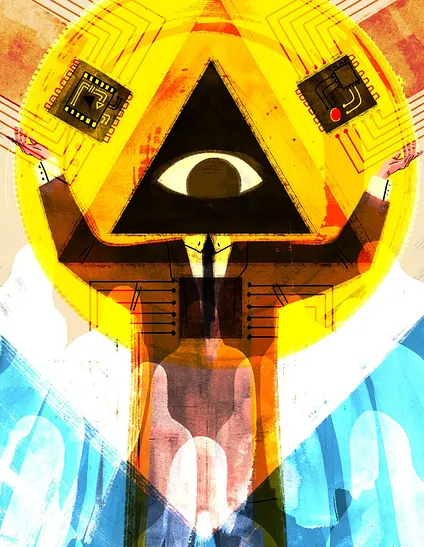
Illustration by Alexander Naughton
As you get older, you learn to detect a certain facial expression, a kind of wild absorption that characterizes a recent infection by an all-consuming worldview. It’s the look of someone utterly taken over by a subject or cause. It doesn’t signal rightness or wrongness, intelligence or stupidity. It just signals being lost in it, a state that precedes both works of genius and complete disasters. Sometimes, it feels like this is the default facial expression in the Bay Area.
The Bay Area is a place of cults. I don’t mean cults in the most literal sense, the kind where people are cut off from friends and family by force, assemble in communes, and believe no one outside understands the truth. I mean cults in the more pedestrian sense: totalizing movements where people are cut off by tacit social pressure, live in group houses, and believe no one outside understands the truth.
These movements are typically organized around the belief that they’ve found the one set of ideas and behaviors that will allow them to triumph in the difficult times ahead and come to own the future. These are people who’ve uncovered the Answer, the point of human life in this era, to which all else should be subordinated.
In the Bay Area today, we find (among others) AI accelerationists, rationalists, and the modern spiritual scene. The Answers proposed by these groups, respectively, are: “scale is all you need,” “rationality is systematized winning,” and “we must awaken and remake civilization.” Do you get the flavor?
It’s interesting that the Bay has a reputation for being a free-thinking place. I suppose it is, in the sense that here you’re welcome to choose among a variety of beliefs that would be considered insane or heretical anywhere else. But in a place that glorifies contrarianism — but is full of ambitious people — the most memetically fit ideas seed groups, and those groups become subcultures. Sooner or later, you end up with a handful of wildly divergent orthodoxies orbiting one another, rather than real pluralism.
If you’d like to talk about how AI is going to destroy the world, you can go to parties with people who might answer “how are you” with, earnestly, statements like “the fight against Moloch continues.” If you’d like to talk about how AI is going to cure every disease and be our machine God, you can go to those parties too. Want to be someone in the middle, someone with layered interests that extend to art and culture? Those parties are in every other city, not here.
I don’t know whether this is ultimately good or bad. The cultural and technological products of the Bay are so wonderful and so terrible that adding up the final ledger is impossible to do in real time. Call no man happy until he is dead, and all that.
What I want to ask instead is: Why are we like this?
Vanguard mentality
If you want to be famous, you move to LA. If you want to make money, you move to New York. If you want to become powerful, you move to DC. Why do people move to the Bay? To live in the future. To participate in the bright tomorrow. To get in early on a movement that’s going to conquer the globe.
Future-orientation, by its very nature, demands some blindness to the present. You have to believe they just don’t get it yet, where “they” are the people occupied with current fashions, forms of work, and cultural expressions. Everything they take for granted will be swept away. Look at them just walking around, as if everything is normal!
This isn’t a new phenomenon: the peace movement, free love, psychedelics, environmentalism, organic food, Westernized Eastern spirituality, the personal computer, software, dot-coms, social media, the gig economy, startup culture, venture capital, crypto, longevity, AI. The Bay is where the future is perpetually being invented. So it makes sense that you would head here if you want to steer it.
But even when it’s right, they just don’t get it yet is an isolating and potentially dangerous sentiment. It places you in a circle of true believers who alone know where it’s all going. Soon, you’ve got in-group jargon, elaborate pecking orders built on arcane, inward-facing criteria, and niche community figures regarded with prophetic reverence. You might sink years into this identity — long enough that it becomes hard to communicate with outsiders, to get feedback from the world, or to leave your in-group status behind.
Cultural loneliness
In New York, where I lived for three years, it’s obvious that there is no one way to “win,” culturally. If you’re out for a walk in any central area, you’ll encounter many people who find your whole set of priorities absurd, who basically do not respect the prizes you’re striving for. Probably there is no single individual who is aware of all the centers of cultural power — all of the scenes and all of their values — or even a significant proportion of them. This can enforce a healthy level of humility, a certain level of ironic distance between you and your values.
The Bay just doesn’t have that same depth, which makes the culture both more malleable and more naive. For better and worse, you really can reshape the culture here, and there are fewer people around to tell you that what you’re doing is corny. Anyone who is really good at hosting parties can quickly gain a reputation as a key cultural figure. Your group house could be regarded as the next exciting incubator of ideas. Your meditation center might, temporarily, feel like it’s the first to perfectly combine the best of Eastern mysticism and Western depth psychology with zero side effects.
This sense of cultural insubstantiality is also baked into the spatial and climatic configuration of the city. It’s harder to feel like you’re among the multilayered throng of humanity here, because the place is just lonelier. The streets are wider, people walk less, the density level is “NIMBYs have ruled for decades.” The chilly night-time winds rule out sidewalk cafe culture or the kind of bustling evening crowds that make many cities feel vital.
In sum, there are just enough people and money here to sustain large populations of oddballs with intense agendas, but it feels sparse enough that it’s easy to imagine you’re a pioneer, alone with a lucky few on the wind-swept plateau, uncovering the ultimate reality.
Weird patronage
The Bay has an abundance of money from tech and crypto without many visible, time-honored ways to spend it. In New York, there’s a well-defined luxury ladder — fashion, fine dining, real estate. Out here, conspicuous consumption is less respected. What is respected is continuing to participate in building the future even after your career has reached maturity — it is a flex to say, for example, that you sponsored someone’s research if it turns out to be important.
The result is a kind of weird patronage — people offering seed funding to charismatic eccentrics and fledgling movements. Dig into the history of any cult out here, and you’ll find surprisingly established names giving money to what, with the luxury of hindsight, are obviously disastrous projects. If you’re a socially enterprising cult-leader type with a bold new idea, there’s no question that the Bay is where you’ll most likely find money, along with sympathetic ears.
This happens at smaller scales, too. “Woo” movements thrive here in part because the most intelligent and entrepreneurial spiritual types become high-end executive coaches, meditation teachers, bodyworkers — there’s a whole class of service employment that’s basically about transferring emotional and spiritual literacy to tech and business elites. Now, there are high-end service workers everywhere — LA has celebrity nutritionists and ayahuasqueros. But here, they are likely to promote new styles of therapy, models of mind, and ideas about the good life, either via their online audiences or through their clients’ startups. If you have enough Bay Area cultural acumen, you can observe which local spiritual figures are currently influential at big AI labs. That sentence alone tells you a lot about the weirdness of this place.
Love of optimization
Elsewhere, the elite seem to want to exhibit conspicuous balance. It’s cool to be physically fit but also indulge in carbs, to have opinions about the Kendrick/Drake beef but also go to the opera, et cetera. Not here. In the Bay, we optimize. Being interested in the casual or the slow reads as unserious. Speedrun enlightenment! Don’t die! See you in the desert!
I think the primary factor is that future-focus again. For decades, “the future is almost here” has been the mantra of the Bay. And if you believe your place in that future depends on being one of the specific people who ushers it in, it’s easy to discount your present comfort, enjoyment, and balance. In this climate, of course speed and scale seem like the ordinary way of things, the mode a human ought to adopt absent hard constraints.
Again, there are pluses and minuses to a culture that constantly asks, why don’t we do the most intense possible version of this? It’s a question that creates a bubbly environment — one where it feels like anything might erupt. Those eruptions include large and small fortunes, some bizarre parties, and cultural revolutions. You also get a few cults in the mix. I don’t think it’s avoidable. The kind of thirsty mind that comes to the Bay thoroughly wants to be captured.
Sign up to be notified when my book, You Can Just Do Things, is available for purchase.